Shoulder rehab courses are specialized programs designed to help physiotherapists master the evaluation, treatment, and long-term management of shoulder disorders. At Total Health by Hong Kong Sports Clinic, our courses integrate evidence-based rehabilitation, movement science, and applied clinical reasoning to help clinicians deliver more predictable patient outcomes.
Whether you are exploring online shoulder courses for flexibility or seeking immersive in-person training, structured education strengthens diagnostic accuracy, exercise prescription, and rehabilitation strategy — all critical in managing complex shoulder presentations.
Our upcoming course is led by internationally recognized shoulder expert Ann Cools, PT, PhD, offering a rare opportunity to learn directly from one of the most influential educators in modern shoulder rehabilitation.
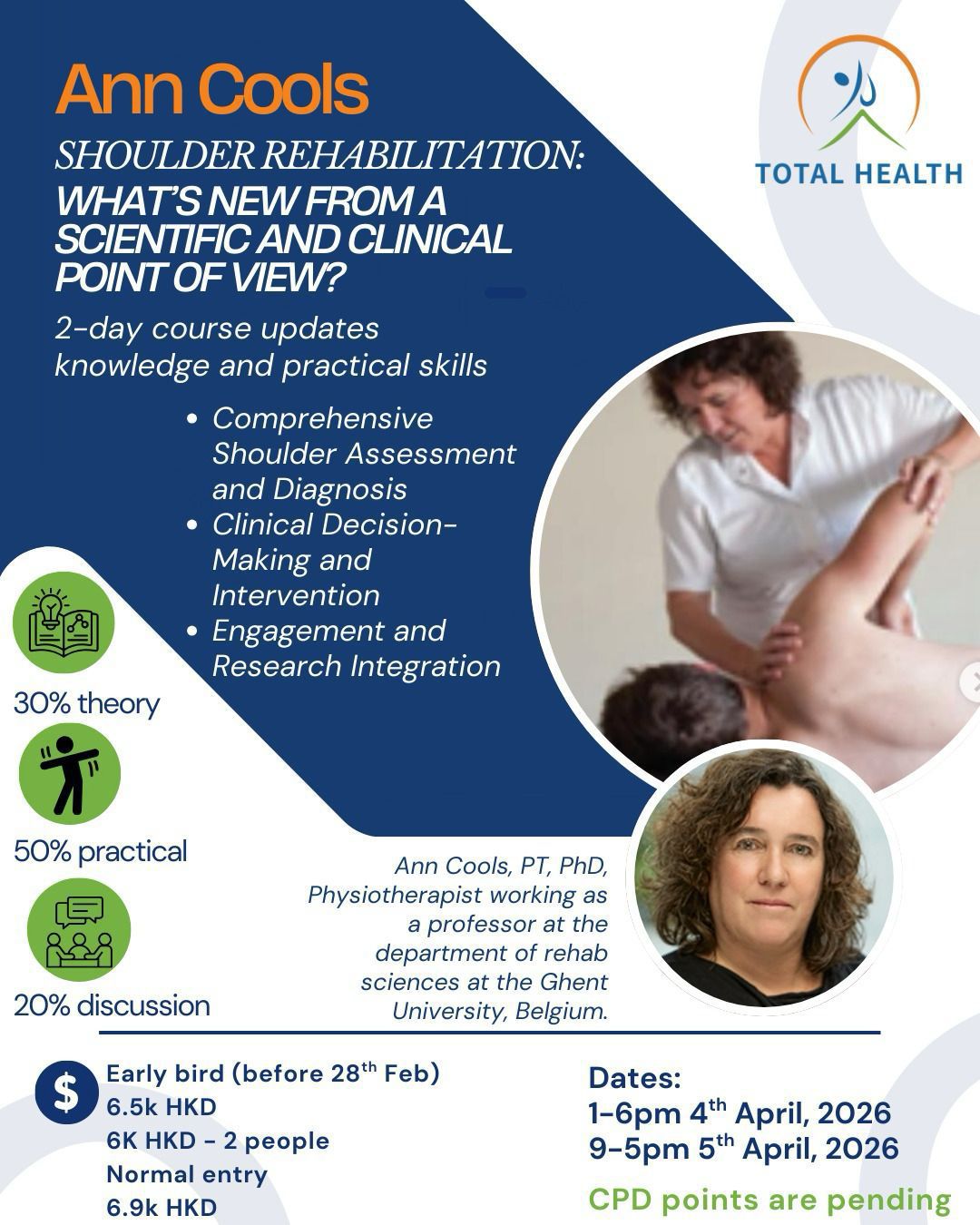
Ann Cools, professor at Ghent University, Belgium, is widely respected for translating research into practical clinical frameworks. Her work has significantly influenced how physiotherapists understand scapular mechanics, muscle performance, and movement dysfunction.
This course is designed to bridge the gap between science and real-world application. Rather than teaching isolated techniques, it builds a comprehensive understanding of shoulder function — enabling clinicians to treat root causes instead of chasing symptoms.
For physiotherapists searching for shoulder courses for physiotherapists that genuinely elevate clinical capability, this program represents a higher educational standard.
Shoulder rehabilitation courses focus on musculoskeletal conditions such as rotator cuff injuries, impingement, instability, postoperative recovery, and movement dysfunction. Unlike generalized physiotherapy education, these programs emphasize clinical decision-making — helping practitioners understand why a treatment works, not just how to apply it.
Clinicians develop the ability to identify biomechanical drivers of shoulder pain, differentiate between contractile and non-contractile dysfunction, apply progressive loading principles, and restore scapular control within the kinetic chain.
The result is greater treatment precision, clearer rehabilitation pathways, and improved long-term outcomes.
The shoulder is the most mobile joint in the human body, relying heavily on neuromuscular coordination rather than structural stability. Because of this complexity, symptom-based treatment frequently leads to recurrence.
Advanced education shifts clinicians away from passive treatment models toward structured, movement-focused rehabilitation. Physiotherapists trained in shoulder rehab typically demonstrate stronger clinical reasoning, faster decision-making, and increased patient trust.
In modern healthcare environments, specialization is increasingly what distinguishes high-performing clinicians from general practitioners.
The shoulder is the most mobile joint in the human body, relying heavily on neuromuscular coordination rather than structural stability. Because of this complexity, symptom-based treatment frequently leads to recurrence.
Advanced education shifts clinicians away from passive treatment models toward structured, movement-focused rehabilitation. Physiotherapists trained in shoulder rehab typically demonstrate stronger clinical reasoning, faster decision-making, and increased patient trust.
In modern healthcare environments, specialization is increasingly what distinguishes high-performing clinicians from general practitioners.
Many online shoulder courses provide strong theoretical foundations but lack the clarity required for confident patient care. This training prioritizes usable skills that translate directly into daily practice.
Across two intensive days, participants refine their ability to perform comprehensive shoulder assessments, differentiate between common and complex pathologies, apply evidence-based rehabilitation progressions, and integrate current research into treatment planning.
The course follows a carefully balanced structure — 30% theory, 50% practical training, and 20% clinical discussion — ensuring knowledge becomes clinical competence rather than passive information.
This program is designed for clinicians committed to professional growth and treatment precision. It is particularly valuable for physiotherapists managing orthopedic or sports-related injuries, rehabilitation professionals working with postoperative shoulders, sports clinicians supporting overhead athletes, and early-career practitioners aiming to strengthen diagnostic confidence.
Because shoulder disorders remain one of the most common reasons patients seek physiotherapy, advanced competency supports both clinical effectiveness and long-term career progression.
Both learning formats offer meaningful advantages depending on a clinician’s goals.
Online education provides flexibility and allows practitioners to revisit rehabilitation frameworks, movement analysis, and lecture material at their own pace. It is especially effective for developing theoretical understanding.
In-person training accelerates skill acquisition through tactile learning, manual therapy practice, movement correction, and real-time clinical feedback.
Many physiotherapists benefit most from combining digital learning with practical workshops — gaining both conceptual clarity and hands-on confidence.
Education directly influences how clinicians assess, treat, and communicate with patients. Physiotherapists who complete structured shoulder training often report greater confidence when managing persistent pain, clearer exercise progression strategies, and improved ability to set realistic recovery expectations.
From a practice perspective, specialization elevates professional credibility and naturally expands referral networks — particularly within orthopedic and sports medicine communities.
Investing in shoulder education is therefore not only a clinical decision, but a strategic career move.
Instructor: Ann Cools, PT, PhD
Professor, Department of Rehabilitation Sciences, Ghent University
Dates:
4 April 2026: 1 PM – 6 PM
5 April 2026: 9 AM – 5 PM
CPD Points: Pending
Investment:
Early Bird (before 28 Feb): 6.5k HKD
Bring-a-Friend Rate: 6k HKD each
Standard Entry: 6.9k HKD
To maintain a high-quality practical learning environment, participation is intentionally limited.
Our educational philosophy mirrors our clinical model: structured, evidence-driven, and outcome-focused. Training is delivered by experienced clinicians actively involved in shoulder rehabilitation, ensuring the material reflects current practice rather than outdated theory.
The program emphasizes applied clinical reasoning, real-world case integration, progressive rehabilitation design, modern strength and conditioning principles, and patient-centered movement restoration.
When expertise becomes visible, patient trust follows — and with it, sustainable professional growth.
Rising participation in recreational sport, sedentary work patterns, and aging populations have contributed to increasing rates of shoulder dysfunction worldwide. As a result, physiotherapists with advanced shoulder training are increasingly sought after for their ability to deliver efficient, evidence-based care.
Consistent professional development remains one of the strongest predictors of clinical excellence in musculoskeletal practice.
Courses led by globally recognized educators rarely remain available for long — particularly within a clinical niche as essential as shoulder rehabilitation.
If your goal is to treat shoulder conditions with clarity, confidence, and measurable success, this course provides the framework to move forward.
Reserve your place today and position yourself among physiotherapists known for clinical excellence.


