Quick answer: Acne in Chinese is 暗瘡 (àn chuāng), the everyday word in Hong Kong, or 痤瘡 (cuó chuāng), the medical term. Traditional Chinese Medicine (TCM) links acne to heat and dampness, and uses a face map that ties each area of the face to an organ. The face map is a traditional idea rather than a diagnostic test, and there is little good evidence that herbs or acupuncture clear acne, so medical treatments from a pharmacist or doctor remain the first choice.
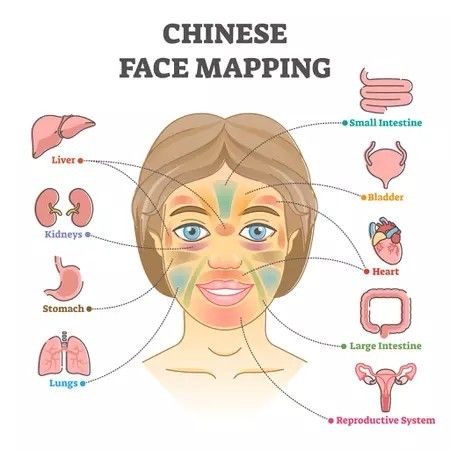
The TCM face map
In TCM, where spots appear on the face is read as a sign of which organ system may be out of balance. This builds on a passage in the classical text Suwen (素問) about where redness first shows in heat illnesses. It links:
- Forehead: the Heart (心)
- Left cheek: the Liver (肝)
- Right cheek: the Lung (肺)
- Nose: the Spleen (脾)
- Chin: the Kidney (腎)
Many modern TCM practitioners also link spots around the mouth to the digestive system, and spots on the chin to the menstrual cycle and hormones. In TCM, organs such as the “Liver” or “Kidney” describe functional systems, not the physical organs a doctor would test.
Most dermatologists don’t use a face map to diagnose illness, but where spots appear can give clues about triggers. Spots along the chin and jawline are often linked to hormones, and spots along the hairline can come from hair products.
Lifestyle tips by area, from the TCM tradition
TCM practitioners often pair the face map with simple lifestyle advice. Most of it is sensible for anyone with acne:
- Forehead: linked in TCM to stress and overthinking. Manage stress and aim to sleep before midnight.
- Cheeks: linked in TCM to the Liver and Lung. Keep active and look after your mood.
- Nose and around the mouth: linked in TCM to stomach and intestinal heat. Eat lighter meals, cut down on spicy and greasy food, and eat plenty of high fibre fruit and vegetables.
- Chin: linked to the menstrual cycle. Get enough rest, especially in the days before your period.
- Chest and back: linked in TCM to damp heat and stress. Wear breathable clothing and shower after sweating.
On diet, research suggests that foods that raise blood sugar quickly, such as white bread and fries, may make acne worse, although not all studies agree.
How TCM describes acne
TCM sees acne mostly as wind heat, lung heat or blood heat, and sometimes as damp heat or blood stasis. A practitioner decides which pattern fits from your skin, symptoms, tongue and pulse. Common patterns include:
- Lung wind heat (肺經風熱): red spots that TCM links to heat in the Lung channel.
- Spleen and stomach damp heat (脾胃濕熱): oily skin with pustules.
- Excess liver heat (肝火旺): red spots with irritability, in TCM terms.
- Blood heat (血熱): red, swollen, hot and painful spots.
- Imbalance of the Chong and Ren vessels (沖任不調): spots that flare with the menstrual cycle.
Depending on the pattern, a TCM practitioner may suggest Chinese herbal medicine or acupuncture. As the next section explains, good evidence that these help acne is lacking.
What does the research say?
Good evidence is lacking. A Cochrane review of complementary treatments for acne found inconsistent results and a lack of good quality evidence for herbal medicine, acupuncture and wet cupping. Treatments with good evidence, such as benzoyl peroxide and retinoids, are available from a pharmacist or doctor. Retinoids are not suitable for everyone, so tell your doctor or pharmacist if you are pregnant or trying to get pregnant.
Safety
- Pregnancy: some Chinese herbs, such as peach kernel (桃仁) and safflower (紅花), are traditionally avoided in pregnancy. If you are pregnant or trying to conceive, don’t take herbal remedies unless your doctor agrees.
- Acne medicines in pregnancy: isotretinoin capsules must not be taken in pregnancy or if you are trying to get pregnant, and you should check with your doctor before using retinoid creams or gels.
- Interactions: herbs can interact with medicines. If you take isotretinoin, tell your doctor about any herbal remedies or supplements. Tell your doctor and your TCM practitioner about everything you take.
- Don’t pick or squeeze spots, as this can lead to scarring.
Simple skin care for acne
- wash your skin twice a day with a gentle cleanser
- use non-comedogenic products, which won’t block pores
- remove make-up at the end of the day
- don’t scrub your skin, as this can irritate it
When to see a doctor
See a doctor if your spots are deep, painful or leaving scars, if treatment from a pharmacist isn’t working, if acne is affecting your mood or confidence, or if the skin around the spots is hot, swollen and red.
Frequently asked questions
What is acne in Chinese?
The everyday Hong Kong word is 暗瘡 (àn chuāng), and the medical term is 痤瘡 (cuó chuāng). Hong Kong’s Department of Health says acne vulgaris (尋常痤瘡) is commonly called 暗瘡 or 青春豆.
What is the Chinese medicine face map?
It is a traditional way of reading the face, not a diagnostic test. In the classical text Suwen, the forehead is linked to the Heart, the left cheek to the Liver, the right cheek to the Lung, the nose to the Spleen and the chin to the Kidney.
Does acne location mean anything?
It can give clues about triggers. Chin and jawline spots are often hormonal, and spots along the hairline can come from hair products.
Does Chinese medicine work for acne?
Good evidence is lacking. A Cochrane review found inconsistent results for herbs, acupuncture and wet cupping. Pharmacists and doctors can offer treatments with good evidence, such as benzoyl peroxide and retinoids. Some retinoids must not be used in pregnancy, so mention it if you are pregnant or trying to get pregnant.
How does TCM explain acne?
Mostly as wind heat, lung heat or blood heat, and sometimes as damp heat or blood stasis. Common patterns are lung wind heat (肺經風熱) and spleen and stomach damp heat (脾胃濕熱).
Sources
- NHS: Acne
- Cochrane 2015: complementary and alternative medicine for acne
- Cleveland Clinic: What your acne face map can tell you
- American Academy of Dermatology: Can the right diet get rid of acne?
- Hong Kong Department of Health: 尋常痤瘡
- CUHK Hong Kong Institute of Integrative Medicine: integrated Chinese and Western medicine for acne
- NHS: Medicines and herbal remedies in pregnancy
If your acne isn’t settling, see a pharmacist or doctor.